Welcome to the RoyOMartin Beyond the Board — your snapshot of housing market trends, company performance, and regional development.
Scroll down to explore the latest edition and see how RoyOMartin continues to meet the needs of today’s housing market.
Key updates on housing affordability, building activity, and industry trends.
A look at RoyOMartin’s role in supporting affordable, resilient construction.
City-by-city permitting, starts, and sales information.
The national housing picture heading into Q3 2026 is one of correction doing what corrections are supposed to do. Across the 25 markets tracked in this quarter’s Beyond the Board report, multifamily oversupply built through 2023 and 2024 is being absorbed, starts pipelines have contracted sharply, and the balance between production and demand is slowly, unevenly reasserting itself. Single-family markets in the Sun Belt, the Intermountain West, and the Midwest remain active, grounded in household formation, in-migration, and structural underbuilding that didn’t disappear just because rates stayed high. The condition is not recovery or recession. It is recalibration, and most markets are somewhere in the middle of it.
The defining pressure running through virtually every market this quarter is the gap between demand that remains real and the cost to serve it. Affordability constraints are suppressing first-time and middle-market buyers from Phoenix to Baton Rouge to Salt Lake City, even in markets where prices have pulled back meaningfully. Labor costs are elevated, and in several markets immigration enforcement has begun to tighten the construction workforce directly. Tariffs on materials are adding to project economics that were already thin. Meanwhile, multifamily in the hardest-hit markets like Austin, Dallas, and Salt Lake City is still absorbing last cycle’s supply wave, which keeps rental concessions elevated and new starts subdued. The markets showing the most resilience are those where employment diversity is broadest and where infrastructure investment is driving non-residential construction alongside housing demand.
The signals pointing forward are quieter than the noise, but they’re present. Multifamily pipelines have contracted enough in most markets that the supply overhang will begin to clear through 2027. Pending sales indices are lifting in several western markets. Technology and manufacturing investment is anchoring long-term demand in Phoenix, DFW, Reno, and the Utah corridor. The builder audience reading this report knows that cycles move through phases, and this one is moving. The work is to stay disciplined through the absorption period, read the structural demand in each submarket clearly, and position for the production recovery that follows. The fundamentals still point toward growth in the places where people are choosing to live and work, and steady execution and disciplined decisions keep us Building Tomorrow Together.
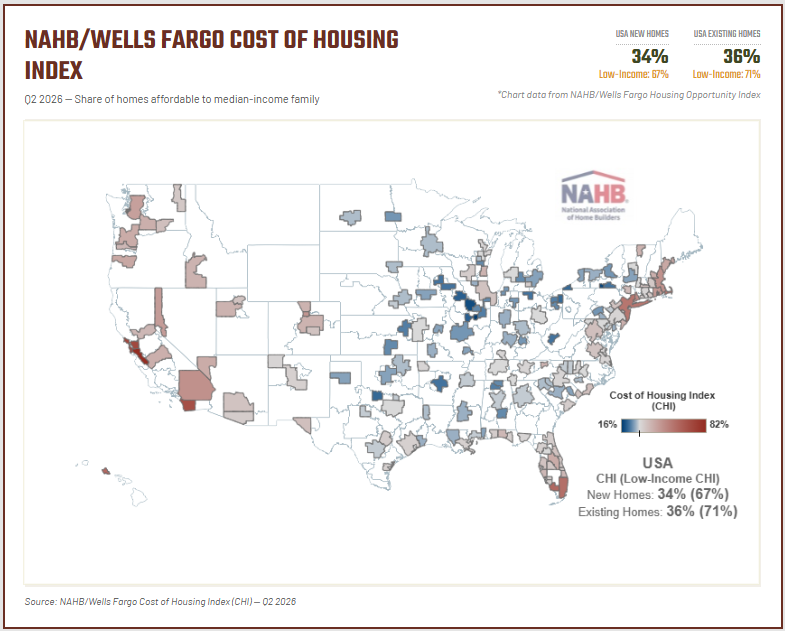
The NAHB/Wells Fargo Cost of Housing Index (CHI) measures the share of a typical family’s income required to cover the mortgage payment on a median-priced home. In Q2 2026, a typical U.S. family needed to allocate 34% of pre-tax income for a new home and 36% for an existing home — figures that climb to 67% and 71%, respectively, for low-income households. The map illustrates significant regional variation, with darker red areas indicating the highest cost burdens, concentrated largely along the West Coast and parts of the Southeast. Of the 175 markets tracked, only 90 fall at or below the 30% threshold considered manageable, while the remaining markets leave families cost-burdened or severely so.
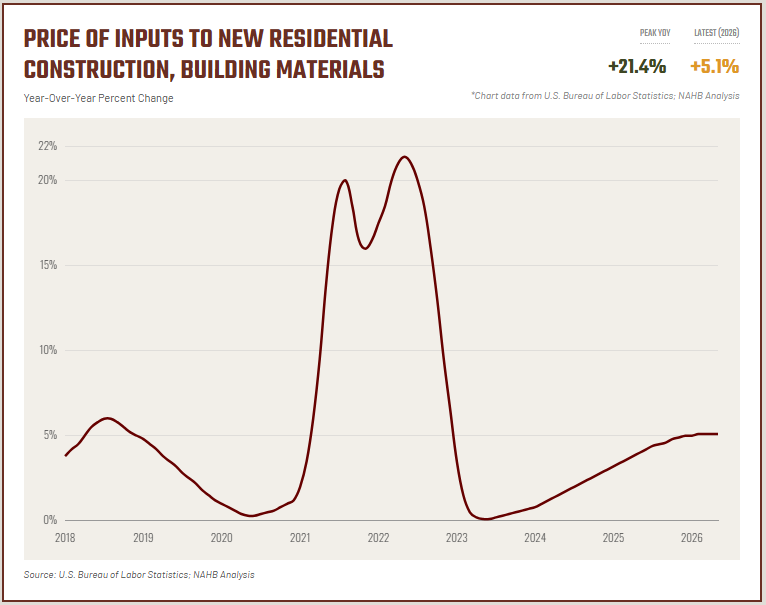
After surging to more than 20% year-over-year during the post-pandemic building boom of 2021–2022, residential building material prices fell sharply and stabilized through 2023 and 2024. Now, prices appear to be creeping back up, rising 5% year-over-year as of mid-2026 — the highest rate since December 2022. While still modest compared to the volatility of recent years, the upward trend bears watching, particularly as energy prices remain elevated and goods continue to represent the largest share of construction input costs.
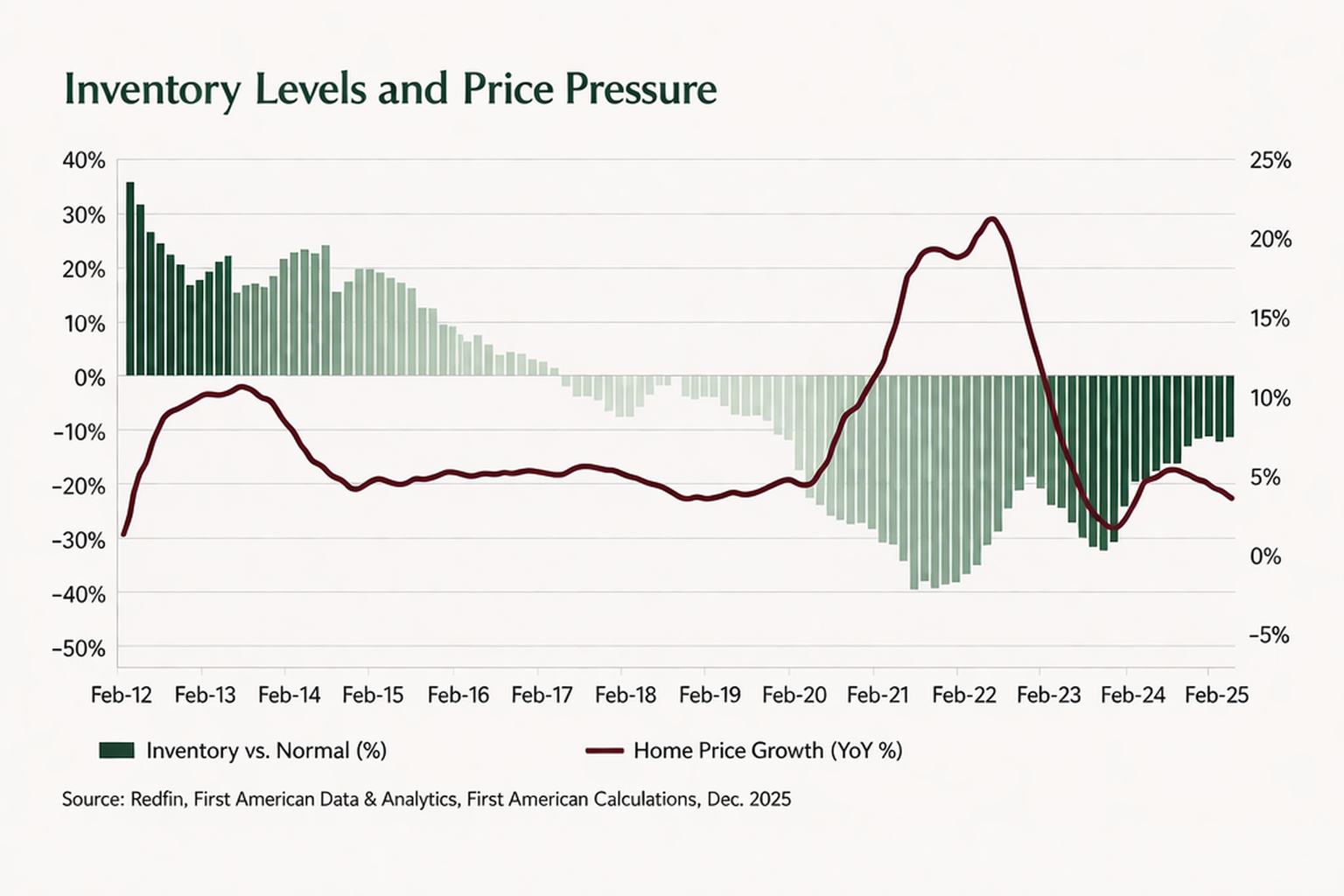
Housing inventory has shifted from well below normal levels to a meaningful surplus in the last couple of years, while price growth has slowed sharply from its 2021 peak. As inventory has increased, price appreciation has cooled, reinforcing the inverse relationship between supply and price pressure.
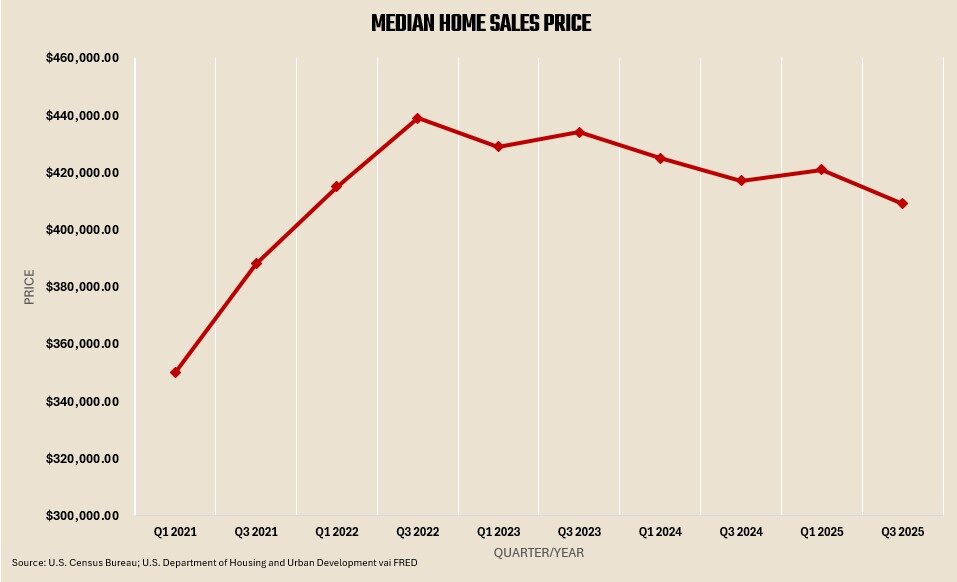
Home prices climbed sharply from 2021 through mid-2022, reaching a peak before softening and becoming more volatile through 2023–2025. Overall, prices have stabilized slightly below peak levels but remain elevated compared to pre-pandemic values.
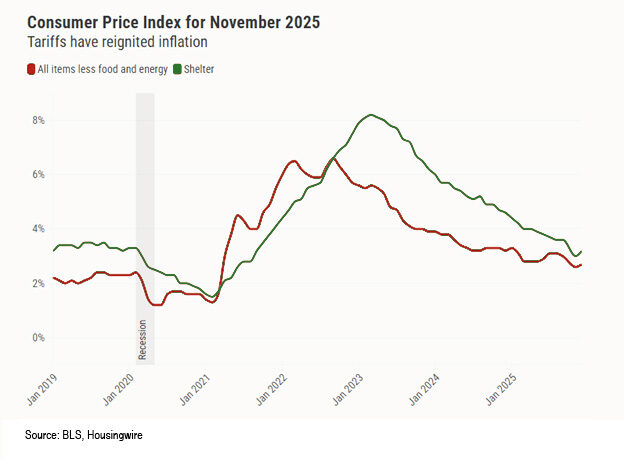
Inflation surged through 2021–2022, peaking in 2022–2023, before steadily easing into 2024 and 2025. However, both core inflation and shelter costs remain elevated relative to pre-pandemic levels, suggesting persistent underlying price pressure.
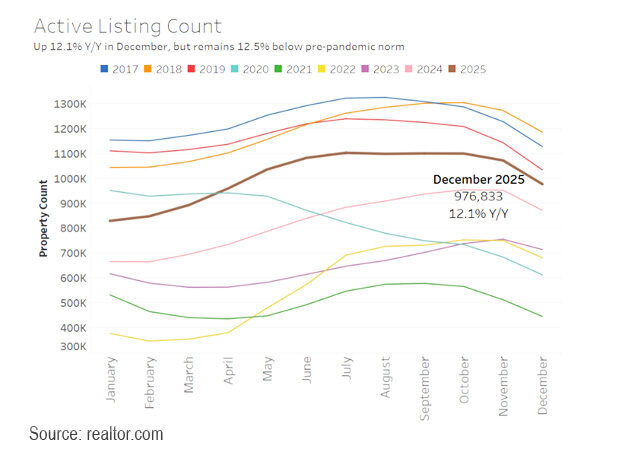
Active listings rose modestly in 2025, finishing December up 12.1% year-over-year, but still below pre-pandemic levels. Inventory followed a typical seasonal pattern—building through midyear before tapering off into year-end—while remaining meaningfully lower than peak years like 2017–2019.
Sources:
We’re constantly uncovering new ideas and industry perspectives. Check back soon for upcoming episodes, innovations, and stories that move the forest products industry forward.
7.3 Months of Supply (MOS)
3.2 Under Construction MOS
Albuquerque is carrying an interesting tension: meaningful structural undersupply combined with a negative annual job growth reading. The Pacific Fusion and AeroVironment investments are real and consequential for long-term employment diversification, but they’re future-state demand catalysts — neither is yet generating significant residential absorption. Current starts are pulling back, multifamily production is contracting, and the metro’s job market is running in reverse. The 5.7% underbuilt position provides a floor against oversupply risk, and single-family permits are essentially flat YTD — not a contraction. For the near term, this is a market in a holding pattern waiting for the defense and advanced energy hiring to translate into housing demand.
Baton Rouge is a market where the future demand story and the current supply story are running in opposite directions. Single-family production is at a decade low, insurance costs are suppressing buyer feasibility, and the City of St. George incorporation is adding regulatory uncertainty in the southeastern EBR corridor. Meanwhile, the industrial and data center investment underway is among the most concentrated in the South — Hyundai Steel, CF Industries, and Hut 8 represent over $12 billion in committed capital with construction accelerating through 2029. The residential recovery tied to those investments is most likely a 2027–2028 event as permanent operations begin and workforce housing demand materializes in Ascension and Livingston parishes.
Austin’s multifamily correction is the most documented story in the BTB set, and it’s genuinely working itself through. Absorption finally beat deliveries in Q3 2025, the pipeline is thinning, and rents are stabilizing. The single-family side is considerably steadier — permits near flat, demand supported by 19,000+ net new jobs annually, and Samsung’s Taylor fab creating a durable new employment center in Williamson County. The labor competition from $21 billion in total construction starts is the shared challenge for every segment of the Austin market. For the trade channel, single-family production in the Kyle-Buda-Georgetown corridor and semiconductor workforce housing in Taylor and Hutto are the near-term volume opportunity.
Dallas-Fort Worth is the largest residential market in the BTB set by every measure, and it’s in a production moderation cycle, not a distress situation. Starts are down nearly 18% but still running at almost 39,000 annually. Multifamily is working through an oversupply correction in suburban submarkets while the data center and advanced manufacturing buildout at AllianceTexas is generating the kind of employment base that sustains demand through rate cycles. The labor competition from nonresidential projects is real and will keep pressure on residential build costs through at least 2027. For the trade channel, the Collin and Denton County outer-ring single-family markets are the most active production zones, and they’re not stopping.
Northwest Arkansas is one of the fastest-growing metros in the country and it’s building to match, but it’s running into the physical limits of its own infrastructure. Residential permit activity is near historic highs, corporate investment keeps arriving, and population growth continues at a pace most mid-size metros would envy. The binding constraint right now is below-ground — sewer capacity is actively gating development in some of the metro’s most desirable communities. Affordability has eroded meaningfully, regulatory fragmentation across municipalities is concentrating development where approvals are easiest rather than where demand is strongest, and construction labor is competing against public projects. The fundamentals remain excellent; the execution environment is more complicated.
Houston is the second-largest residential production market in the BTB set and it’s navigating a modest pullback — starts down about 6%, multifamily contracting sharply — from a very high base. The Lilly Generation Park investment is the most significant individual employer commitment in the BTB set this quarter, and the broader Gulf Coast LNG and data center buildout keeps Houston’s construction economy active across project types. The near-term concern is the consumer confidence deterioration in the Kinder survey; energy-sector employment cycles have shaped Houston’s housing market before, and the current softening in job-opportunity sentiment warrants monitoring. For the trade channel, master-planned community production in Katy, The Woodlands, and Fort Bend County remains the volume story.
Lafayette is a market defined by two economies running at different speeds. The energy services and LNG supply chain economy is surging — Louisiana’s capital investment reached a record $61 billion in 2025 — and Lafayette is positioned as the regional hub for much of the Gulf Coast LNG buildout now accelerating. The residential market reflects that unevenness: luxury sales at $1M+ are up fourfold since 2019, while the middle market is constrained by insurance costs, affordability compression, and a multifamily development pause that looks structural, not cyclical. For builders and dealers, suburban single-family in the active growth corridors is the near-term opportunity; multifamily is unlikely to recover meaningfully until the insurance environment changes.
9,363
Las Vegas’s 10% underbuilt position is the most compelling structural housing demand signal in the BTB set, but the market is running two conflicting data stories simultaneously — NAHB YTD permit figures show sharp declines while Zonda 2026 estimates project significant increases. That divergence needs editorial resolution. On the ground, production is clearly pulling back from the recent cycle’s pace, but the metro’s demand fundamentals — 15,000 net new jobs annually, active sports and entertainment investment, and deep structural undersupply — argue against a prolonged production pause. Water and land supply remain the hard limits on how much Las Vegas can ultimately grow.
Little Rock is carrying one of the deepest undersupply positions in the BTB market set while simultaneously managing the most concentrated nonresidential construction buildout in the state’s history. Current residential production is contracting — permits are down meaningfully on both sides — but the structural demand case is building. The Google and AVAIO campuses are in the ground, median household income grew 5.5% in 2025, and construction employment in the broader Central Arkansas area grew at the fastest pace in the state. The near-term squeeze is labor availability and affordability at the new-home price point. Longer term, this looks like a market with demand support ahead of it.
18.1 Months of Supply (MOS)
Los Angeles is simultaneously the most constrained and most active housing market in the BTB set. Multifamily permitting surged 85% YOY — driven by state housing mandates, wildfire rebuild demand, and transit-oriented development — but the market sits at 18 months of supply and the insurance crisis continues to limit what’s financeable in fire-adjacent zones. For lumber and building material suppliers, the real story is the volume of construction activity underway: Olympic infrastructure, Purple Line extension, wildfire rebuilds, and multifamily deliveries are all running concurrently. Sustained construction demand through at least 2028 is the baseline expectation regardless of the for-sale market’s affordability conditions.
10.2 Months of Supply (MOS)
Ogden is a market caught between its current fundamentals and its long-term potential. The current reading — elevated inventory, negative job growth, starts outpacing sales — signals a near-term supply digestion challenge. The long-term case is compelling: Hill AFB and the Sentinel program provide a stable, growing federal employment base; the 2034 Olympics is bringing lifestyle buyer attention; and the West Weber Industrial District’s 3,400-acre master plan positions the corridor for significant future demand. The permit data divergence between NAHB and Zonda needs editorial resolution before this card publishes. For the trade channel, residential production tied to Hill AFB workforce remains the near-term constant; the Olympic-driven appreciation is concentrated in higher price points.
Oklahoma City has an unusual profile: starts are up 14% over the last 12 months while net job growth is slightly negative and inventory has risen above nine months. That combination suggests builders pushed production into a market now working through a modest oversupply correction. The Tinker AFB aerospace cluster — 44,539 workers and 2,900+ new openings projected — provides real stability that separates OKC from purely energy-dependent metros, and MAPS 4 investment continues to improve livability. For 2026, the question is whether the Continental Coliseum construction catalyst and aerospace hiring can offset energy sector softness before the inventory position requires pricing adjustments.
17,566 | -23.6%
Phoenix is working through a production pullback while a generational economic catalyst accelerates beneath it. Annual starts are down nearly a quarter over the last 12 months, and the market carries a modest overbuilt position, but multifamily absorption is recovering and new home sales remain substantial at over 20,000 units. TSMC’s expanded commitment positions the north Phoenix corridor for durable, workforce-driven housing demand through the end of the decade. The near-term risk is labor competition — the same tradespeople serving residential projects are being pulled toward semiconductor and data center construction. Water supply remains the structural wildcard that no investment announcement resolves.
Provo-Orem-Lehi is one of the most structurally dynamic markets in the BTB set — 133,000 new residents in six years, TI fabs expanding, Utah City building out a transit-anchored new community — but it’s working through a modest supply correction at 8.7 months of inventory. The affordability gap at $700,000+ in Lehi has shifted demand toward Eagle Mountain and Saratoga Springs, where builders are delivering in the $525,000 range. Tech sector concentration risk is real and worth monitoring, but the BYU and UVU enrollment base provides a demand floor most tech-hub markets lack. Southwest Utah Valley is the active production zone for the next several years.
6.1 Months of Supply (MOS)
4.5 Under Construction MOS
Reno is managing a significant starts correction while its long-term demand case remains intact. The California migration pipeline is structural — No. 1 destination for San Francisco buyers nationally — and data center and airport construction are providing a durable base of nonresidential activity. The challenge is that the industrial expansion that drove the prior housing cycle is in retreat: speculative industrial space is sitting vacant, new starts have paused, and the workforce housing demand that followed warehousing and logistics jobs is moderating accordingly. For residential builders, the near-term opportunity is equity-rich California buyer product above $600,000; the entry-level market is constrained by price relative to local incomes.
Sacramento is one of the more structurally sound housing markets in California right now. It sits in meaningful undersupply, it’s adding residents at a consistent clip from Bay Area migration, and Bosch’s semiconductor investment signals growing long-term employment diversification beyond state government. The current starts pullback — down 25% over the last 12 months — is the near-term production story, and the NAHB-Zonda permit divergence should be resolved before this card is published. For the trade channel, the Folsom Ranch master community and the Upper Westside plan (9,400 homes approved June 2026) represent meaningful pipeline for the back half of this decade.
12.6 Months of Supply (MOS)
Salt Lake City is sitting with elevated inventory while generating the strongest Pending Sales Index in the BTB set — a pairing that reflects the multifamily supply overhang from 2023’s record deliveries working down as new buyer demand grows. The Power District, The Point at Draper, and the 2034 Olympics infrastructure pipeline represent the most concentrated mixed-use development program in Salt Lake Valley since the 2002 Games. Data center labor competition is driving 13%+ annualized nonresidential construction cost escalation — a broad-based pressure affecting every project tier. Long-term growth is among the most durable in the Mountain West; the near-term task is working through 12.6 months of supply.
San Antonio is in a buyer-friendly transition after a sustained seller’s market, with active listings up 12.4% YOY, days on market at 87, and builders offering incentives across the board. The data center investment coming to Bexar and Guadalupe counties is substantial and is generating both construction employment and the kind of tech-infrastructure workforce demand that will translate into residential absorption in the Schertz-Cibolo and New Braunfels corridors. The near-term headwinds are immigration enforcement effects on construction labor and the multifamily market’s sharp production pullback. The Edwards Aquifer drought situation and the pending UDC data center zoning amendments are regulatory processes worth tracking through the back half of 2026.
San Diego is managing the deepest starts contraction in the California BTB group, but the demand signals underneath it are notably strong. A Pending Sales Index up nearly 28% YOY is unusual in a market with 14 months of supply, suggesting buyers are engaged even as builders wait for conditions to improve. The defense and life sciences employment base — $39 billion in annual defense spending, Shield AI’s $2.25 billion venture round — provides durable demand support. At $1.07 million for a single-family median and with insurance carrier withdrawal in fire-zone communities, the market has real limits on who can participate. Production will recover; the question is where and at what price point.
24.2 Months of Supply (MOS)
San Francisco is in the early stages of a recovery narrative, but it’s starting from an exceptionally elevated inventory position. The AI-driven office leasing revival is real and consequential — 825 generative AI companies in the Bay Area represent durable employment demand — and the Downtown Revitalization Financing District gives conversion projects a meaningful economic pathway. For builders and lumber suppliers, the near-term opportunity is modest; the production market is constrained by 24 months of supply and construction cost escalation running well above national averages. The recovery will be measured in years, not quarters, and the transit funding vote in November is the clearest near-term binary risk to watch.
Closings are at 3,617 annually, down only 3.0% year over year, holding up better than starts.
Total housing inventory has declined since the start of the year, with 3.7 months under construction and 1.8 months of finished vacant supply, keeping overall supply relatively contained.
Household growth is running at 1.3%, and median household income is projected to rise 3.7% annually over the next two years, supporting longer-term demand.
Tucson is navigating a contraction in starts and a near-term multifamily supply spike while its underlying demand signals hold. The Pending Sales Index is up nearly 14% YOY, the market sits in mild undersupply, and significant public infrastructure investment — led by the $2.67 billion RTA Next plan — is directly serving the Marana and Vail corridors where most new construction is concentrated. Construction employment is under pressure, and the multifamily supply wave of 2026 will take time to digest. Water and groundwater regulatory clarity remain the long-range constraint that infrastructure dollars alone can’t solve.
Tulsa is a market where headline investment activity has outrun the residential production story. Meta’s data center, Pratt & Whitney’s expansion, and the emerging space cluster at Tulsa International Airport are real economic diversification wins. But the residential side is producing below what the market’s own 2024 housing strategy identifies as needed: single-family permits are down sharply, overvaluation is elevated, and absorption above $300,000 is sluggish. The multifamily correction creates opportunity as the supply pipeline thins into 2027, and GKFF’s downtown program continues strengthening urban fundamentals. The demand catalysts are genuine; they’re simply slow-moving relative to current price levels.
Columbus is a market where investment is arriving faster than the labor market can accommodate. The data center and semiconductor buildout is adding construction work at a pace the city hasn’t seen, the Pending Sales Index is up nearly 27% YOY, and Zonda’s 21% overvaluation reading reflects genuine demand-supply tension. The near-term challenge is twofold: the multifamily correction will take through 2026 to digest, and the Intel permanent employment catalyst has been pushed to 2031+. For builders and lumber dealers, the single-family side looks constructive — moderate starts, growing demand signals, structural undersupply — while multifamily needs the current absorption cycle to work through before new starts make sense.
Indianapolis is running two stories at once. The headline is a 23% starts contraction in a market Zonda estimates as 19% overvalued. The underlying story is that Eli Lilly is building what amounts to a small city in Lebanon, IU Health and Signia projects are putting billions into the ground, and the metro’s fundamentals — 3.3% unemployment, 7.6% wage growth — are among the strongest in the Midwest. For dealers and suppliers, the near-term residential environment is soft, but the workforce demand that will refill that pipeline is actively being created through the megaproject buildout. The labor competition for licensed trades is the shared constraint across all of it.
Kansas City is delivering a strong underlying growth story — underbuilt, permits rising on the single-family side, median prices up sharply — but affordability has run ahead of the income base, and Zonda’s 20.4% overvaluation reading is one of the highest in the entire BTB set. The Panasonic and Crown Center investments are the kind of demand catalysts that sustain residential production through a rate cycle, and the metro’s industrial fundamentals (third-lowest vacancy among top-30 U.S. markets) signal continued job growth. The near-term risk is that cost escalation from tariffs, combined with overvaluation, compresses the entry-level and workforce price point precisely when the market most needs affordable production.

The world of OSB sales has not been one for the faint of heart in the first half of 2026. Our industry has been up against sluggish home starts, unchanged mortgage rates, a depleting pool of skilled labor, and one of the most volatile flatbed transportation environments that we have ever seen. In fact, the data around flatbed carrier participation and rate volatility suggests that, in late Q1 and early Q2 of this year things were worse than the COVID era. These are just a few of the factors that stand out to us as we continue to struggle to build affordable homes in the US. Most sources suggest that we are in for much of the same regarding headwinds in new home construction for the balance of 2026 and into 2027.
Our team at RoyOMartin is built for the adversity that we have seen in the marketplace this year. Despite the challenges, we have much to be excited about. We reintroduced our TuffStrand Weather Resistant Barrier™ tape-and-panel system this year and have gained acceptance in several markets. We anticipate sales volume growth on this product in the days to come as builders see the benefits of this system versus traditional OSB and Housewrap. We have also seen significant growth in our Eclipse® Radiant Barrier sales this year. We look forward to bringing more new and innovative products to the market in the months to come.
I want to conclude with a restatement of a commitment that you all have heard from the RoyOMartin leadership team many times. We are committed to running our production facilities at capacity regardless of market conditions. We take great pride in this commitment and will not restrict production due to any market related factors. In fact, our Oakdale, LA, OSB team set an all-time annual production record this business year with over 815mmsf produced! We will continue to operate intentionally around safety and the well-being of our team members. Thank you to each of you for your loyal support and partnership with RoyOMartin.
Paul Pfingsten
Director of OSB Sales

As we closed out the first half of 2026, the only thing predictable has been the unpredictable. We began the year with frigid temperatures that forced plant closures, and since then have navigated scalding summer heat, heat advisories, and weather that can’t seem to decide between monsoon and drought. Louisiana weather, as always, keeps us on our toes, and reminds us that flexibility is not optional in this business.
Through it all, plywood has had a good year. The market has seen its share of headwinds. Southern plywood lost a mill to weather-related damage, and tariffs were enacted largely as anticipated, but the fundamentals remain solid. While new and existing home sales are still suppressed, people continue to invest in what they have. Repair and remodel activity remains strong, and we are seeing a small but welcome uptick in new furniture consumption as a result.
On the production side, Chopin completed its second route-and-fill, which was another step forward as we continue to invest in and upgrade our facilities. We are proud of the progress being made and remain committed to operating at a high standard.
Looking ahead, we expect a steady plywood market. Will prices change? Yes, they always do. Back-to-school, college football season, the holidays, and yes, the weather will all play their part. But plywood benefits from a diverse end-use market, disciplined production, and a loyal customer base. We feel good about where we stand.
Our focus is, and always will be, the same: keep our people safe, make a quality product, and take care of the customer. Thank you to our owners, our team members, and our customers. Stay safe, and we look forward to a strong second half.